Apr 10 2009

TOE Exclusive :: Mia Pearlman Interview

Published by herocious at 9:22 am under ::ART::, ::INTERVIEWS::

I don’t remember a time before I was interested in art.
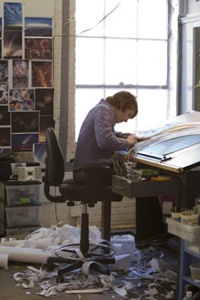
mia pearlmanWhere were you born and where do you live now?

I am a born and bred New Yorker, resident of Fort Greene, Brooklyn and a die-hard Mets fan.

Tell us about your education.

I realized I was an artist at age 12 when I had to choose where I wanted to go to high school. It was clear to me that the one constant interest in my life had always been drawing (while wanting to be a ballerina, scientist, etc) and that it probably would be forever. Luckily, I got into LaGuardia High School (otherwise known as the “Fame” school) where I majored in studio art, after an interview, 3-hour drawing test and portfolio review. After that I went to Cornell University where I nominally majored in Painting but made a series of interactive sculptures for my BFA thesis. Both were incredible experiences, as much for the exposure to my peers as the education they offered.

What is the one book you will regret never having read?

If I had to choose one book I guess I would say the Old Testament, but I don’t believe in regrets because there’s always an upside to every choice, even the stupid ones. Truthfully, I’ve always sort of wished I’d had a British public school education where I would have read all the classics in Greek and Latin. But realistically I would never have survived a week: I’ve never been good with rules or uniforms or authority figures and am completely incapable of doing basic “maths.”

What is your favorite ingredient?

Favorite ingredient… fresh thyme.

How did you get interested in art?

I don’t remember a time before I was interested in art. I grew up surrounded by art and creative people, and started going to museums as a young child. In retrospect I now realize that not every child is so obsessed with colors, the precise wallpaper pattern in each room, the exact placement of throw pillows on the bed, the specific texture of a leaf, etc. A few years ago I figured out that not everyone sees every letter and number as being a different color. I guess I assigned those early on and to this day see all words as having very specific colors based on the colors of their individual letters. Do other people have that, and if so, is 3 green and 9 purple? Because they are to me.

How has your practice evolved over the course of time?

It is almost laughably the same except that now I have much more confidence in my gut instincts and don’t think about how my process “should” go, look, how other people work, etc. My work is very intuitive, inspired by nature, life experience and my imagination.

My “practice” is as follows: I walk to my studio, which takes about 12 minutes. I unlock the door, say hello to my plants (I am obsessed with succulents), put my stuff down, and turn on WFAN during baseball season or music or NPR if its not too depressing. Then I work. Sometimes I dance around to salsa music or take a walk if I get stuck. When I’m done, I go home or out for Thai food with my husband.

Since college I’ve had the same piece of cardboard on my wall, with a James Baldwin quote in Sharpie: “The purpose of art is to lay bare the questions which have been hidden by the answers.” I hope that if I have a practice this is it.

What do you consider to be your greatest success?

Making work that I’m really excited about and keeps me up at night mulling over ideas. Even though I’m tired and should probably sleep.

If you could ask yourself one question, what would it be and how would you answer?

Q: When are you going to get health insurance already?
A: Good question.

—0—

For more from the artist, including a video in which she discusses many of the themes related to her work, visit her at http://miapearlman.com

::Image of Mia Pearlman by Catrina Genovese::
Related TOE posts:


4 responses so far

4 Responses to “TOE Exclusive :: Mia Pearlman Interview”

  1. herociouson 10 Apr 2009 at 10:49 am

    I just wanted to thank Mia Pearlman for these words and ask a few more questions that I neglected to ask before.

    I’ve read that your cut paper has a life expectancy of 2-3 weeks. Why is this? Does the basic white drawing paper lose its starch? If this is the case, paper is kind of like skin in that it, too, loses its “starch,” only we use other words to describe it, like elasticity. “A skin loses its elasticity like paper loses its starch.” Is this analogy accurate?

    My next question is related to the first: What do your installations look like after 2-3 weeks? What is done with them?

    My penultimate question is a stream of consciousness: Did you know, before you started your first cut paper piece, when it was still an embryo inside you, did you know that what you were about to create would be so temporary? How do you describe this process? Among these words – Extinction, Decay, Rebirth – which, if any, would you consider the most fitting descriptor? Is this process destructive or regenerative?

    Lastly, how do you feel about writer’s burning their manuscripts?

  2. Mia Pearlmanon 10 Apr 2009 at 11:54 am

    Wow, extra credit questions so soon!

    #1:

    Hmmm, I’m not sure where you read this but that is not the case. I’ve had installations up for months at a time and will have one Museum of Arts and Design in NY for over 4 months starting in September. Paper does change, of course, depending on the weather, humidity levels, etc. On wet days it may sag a little but it will rebound on dry ones to its original form. Most galleries are climate controlled, so this is rarely an issue.

    Paper’s changeability is part of it’s appeal—I love that it has a life of its own, and is ephemeral in nature, just like exhibitions, clouds, weather, life, time, seasons, belief systems, species, etc. I think of my work and my process as a balance between chance and control: paper provides an element of chance that is integral to this work.

    #2:

    They look the same after 2-3 weeks provided there is climate control and no fires, floods, etc, just like any work. On my website I have a “How it Happens” photo essay that shows the process of transporting, installing and de-installing the work. And a little after-party debauchery for fun! http://miapearlman.com/install_shots.htm

    #3:

    I’m not crazy about the embryo metaphor—if I were male would my ideas be compared to childbirth? I certainly don’t imagine they come from my ovaries, much less require someone else to fertilize them!

    The temporary, ephemeral character of my work is very intentional. I am interested in those moments in which its impossible to tell if a form is contracting or expanding, coming or going, etc. The ambiguity of form, the fact that everything in life is in flux, that we are not really in control although we might like to believe so, the constancy of change—the ephemeral form of the work reflects the ideas within. If I had to apply a descriptor to the work it would either be “ephemeral” or “ambiguous.”

    #4:
    I don’t know but I’m a fan of cremation. Into the fire!

  3. herociouson 10 Apr 2009 at 12:18 pm

    For awhile I was ready to cede that I made up the 2-3 week lifespan of your work, but then I found where I had read it:

    “The arrested motion in the pieces invokes wonder, and is unusually photogenic, a vital attribute for work with a life span of two to three weeks.”

    From: Machina, no. 29, September 2008

    Now that I know your paper installations have a lifespan of 4 months, my questions aren’t as urgent. Come to think about it, 2-3 weeks is a very short lifespan for paper, absurdly short. 4 months sounds more reasonable.

    I will cede, however, that my embryo metaphor was more for the sake of metaphor than common sense.

    Thanks for your response!

  4. bridgeton 11 Apr 2009 at 10:56 am

    Wow. It’s very nice to hear an artist describe their process and thoughts on their work so openly. It seems that most artists have a similar story of not remembering a time without art, without being already caught up in it, and feeling like an artist. I’m somewhat envious of this natural gravitation toward a certain talent at a young age. Instead of this, I have found myself pulling at various interests and attempting to work hard at them in phases. Some end up working out more than others. The art, however, definitely came late.

    The most intriguing part of this interview for me:

    “A few years ago I figured out that not everyone sees every letter and number as being a different color. I guess I assigned those early on and to this day see all words as having very specific colors based on the colors of their individual letters. Do other people have that, and if so, is 3 green and 9 purple? Because they are to me.”

    You seem to be experiencing color-graphemic synesthesia! I have planned to post on the topic for a while now, but will definitely be following up with one soon. Synesthesia is a very rare condition, but color-graphemic is the most common manifestation of it. The wikipedia article: http://en.wikipedia.org/wiki/Synaesthesia is a good place to start, but many interesting books have been written on the topic. Perhaps you’d be interested in reading others’ accounts of their experiences with synesthesia- you’d probably relate!

    Keep up the good work. Very interesting.

Trackback URI | Comments RSS

Leave a Reply